
Nutanix Is Making Service Providers a First-Class Tenant
SP Central delivers the control plane MSPs have been building by hand. The verification badge might matter just as much.

Multitenancy has always been the part of Nutanix that service providers had to build themselves. The platform gave you the primitives: VPCs, Flow policies, categories, role-based access. What it never gave you was a control plane designed around the idea that the people consuming the infrastructure are not the people operating it. Every MSP running Nutanix today has closed that gap by hand, with separate Prism Central instances, custom onboarding runbooks, and a network segmentation design that has to be reinvented per tenant.
At .NEXT in April, Nutanix announced it intends to close that gap itself. As someone who has spent years building that layer by hand, this is the announcement I have been waiting for, and it deserves a closer look than the headlines gave it.
What Was Actually Announced
Two things, and they solve different problems.
The first is Service Provider Central, a new product expected in the second half of 2026. It promises enterprise-grade multitenant IaaS on the Nutanix Cloud Platform, operated through a single pane of glass in Nutanix Central. Each tenant gets a private cloud environment with its own Prism experience, managing its own compute, storage, networking, identity, and authorization. The provider keeps centralized operational control and governance.
The second is the Powered by Nutanix: Verified Solutions program. Service providers whose offerings align with Nutanix architectural standards can earn an official verification badge. The first phase covers private cloud services, with badges for IaaS, including Sovereign IaaS, and Disaster Recovery as a Service.
One is platform. The other is go-to-market. For an MSP, both matter, but for different reasons.
Multitenancy Is a Control Plane Problem
The data plane has never been the hard part. Nutanix VPCs give you overlapping address spaces and routing isolation. Flow gives you policy enforcement that follows the workload. I have built tenant isolation on these primitives, and they work.
The closest thing to tenancy the platform offered above that layer was Prism Central Projects. Combined with categories, RBAC, and NCM Self-Service, Projects let you scope quotas, networks, and provisioning per customer. But Projects are administrative grouping, not tenant isolation. The tenant lives inside your Prism Central, inside your identity domain, separated by policy rather than by architecture. One misconfigured role mapping and the boundary is gone.
What does not scale is everything above the data plane. Who provisions a new tenant, and how long does it take. Who answers when a tenant wants to see their own consumption, manage their own users, or restore their own VM without opening a ticket. Today the honest answers involve either giving tenants access they should not have, or absorbing operational toil the service margin was never designed to carry.
That is the layer SP Central targets. Tenant-scoped self-service on shared infrastructure, with the provider retaining governance, is not a feature. It is the difference between hosting and operating a cloud.
One caveat worth stating plainly. SP Central is announced for the second half of 2026, on a when-and-if-available basis. Plan it as an accelerator on your roadmap, with today’s architecture as the foundation it will build on.
The Listing Is Not a Sticker
The Verified Solutions side is easier to underestimate. Nutanix has run validation programs for technology alliances for years, and verified partners get listed on the Nutanix site where customers actually look. Extending that model to service provider offerings changes the discoverability economics for smaller MSPs.
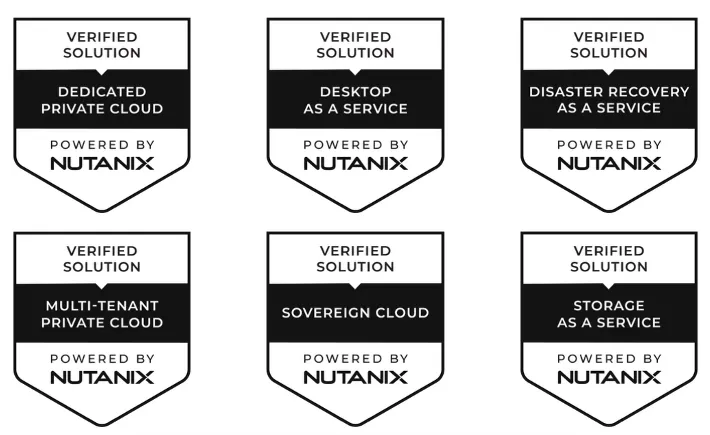
The six Verified Solution badges available in Phase 1 of the Powered by Nutanix program
The detail that makes it credible is the bar for entry. Verification requires a real offering reviewed against Nutanix architectural standards, backed by production customer proof. And the review goes beyond the technical stack: the submission covers the commercial model, SLAs, monitoring and support structure, and operational readiness. Nutanix is verifying a service, not a product. That filters out slideware. A badge that anyone can get is noise. A badge that requires a service running in production, with the operations to back it, is a signal, and signals are what mid-size providers lack when competing against hyperscaler defaults.
For European providers, the explicit Sovereign IaaS badge is the most interesting entry in the list. Sovereignty claims are everywhere right now, and most of them are marketing. A verification path that ties the claim to a reviewed architecture is worth more than another whitepaper.
How to Arrive Ready
SP Central is expected in the second half of 2026, which gives providers something rare: time to prepare for a platform shift instead of reacting to one. Three things to do with that time.
Keep investing in the foundation. The multitenancy you sell today is still built on VPCs, Flow, and disciplined Prism Central design, and none of that work is throwaway. SP Central will sit on top of exactly these primitives, so every improvement to your segmentation model now is a head start on onboarding later.
Treat your network architecture as the prerequisite it is. Tenant onboarding automation amplifies whatever design sits underneath it. Providers who formalize their per-tenant segmentation model before SP Central ships will be the ones who can adopt it on day one.
Start building your verification case now. The Verified Solutions process asks for production customer proof, and that is the right bar: it makes the badge mean something. If you have a real offering running for real customers, you already have most of what the submission requires.
Where This Leaves MSPs
The strategic read is this: Nutanix is treating service providers as a first-class operating model, with platform investment and a public verification path to match. That is the kind of commitment this segment has been asking for. Providers who already treat multitenancy as an architecture, not a workaround, will onboard fastest when SP Central ships, and they are the ones with production references ready for verification today.
The foundation work is the same either way. In the next articles in this series I will get concrete about that foundation: how to design per-tenant network segmentation on Nutanix VPCs, and how to handle traffic inspection and routing with Flow when tenants need more than flat isolation.