
From NDB to Native PostgreSQL Without Migration
The data layer is standard PostgreSQL on LVM. Nothing proprietary.
One question that comes up when evaluating database platforms is portability. If I deploy PostgreSQL through Nutanix NDB today, can I convert it to a native OS-managed instance later if requirements change?
The answer is yes. And the process is straightforward.
This article walks through the technical steps to detach a PostgreSQL database from NDB and run it as a standard Rocky Linux deployment, using the same data directory, the same storage, and the same filesystems. No migration, no export, no rebuild.
What NDB Actually Does to Storage
Understanding how NDB provisions database storage is the first step. It also explains why some details in Prism might look unexpected at first glance.
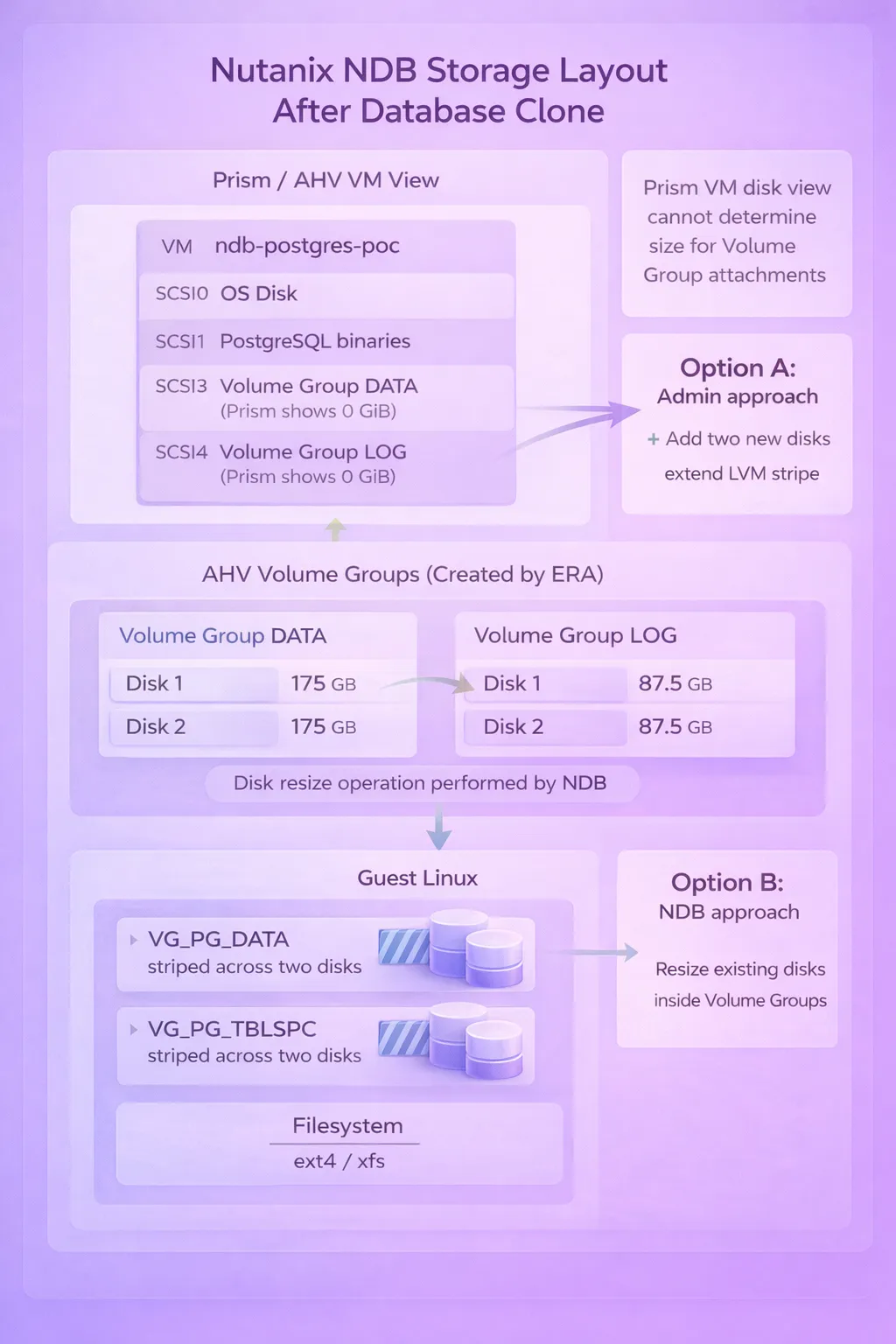
When NDB deploys a PostgreSQL instance, it does not create standard vDisks attached to the VM. Instead, it creates AHV Volume Groups and attaches them via iSCSI. Inside each Volume Group, NDB provisions two disks and configures LVM striping across them for performance.
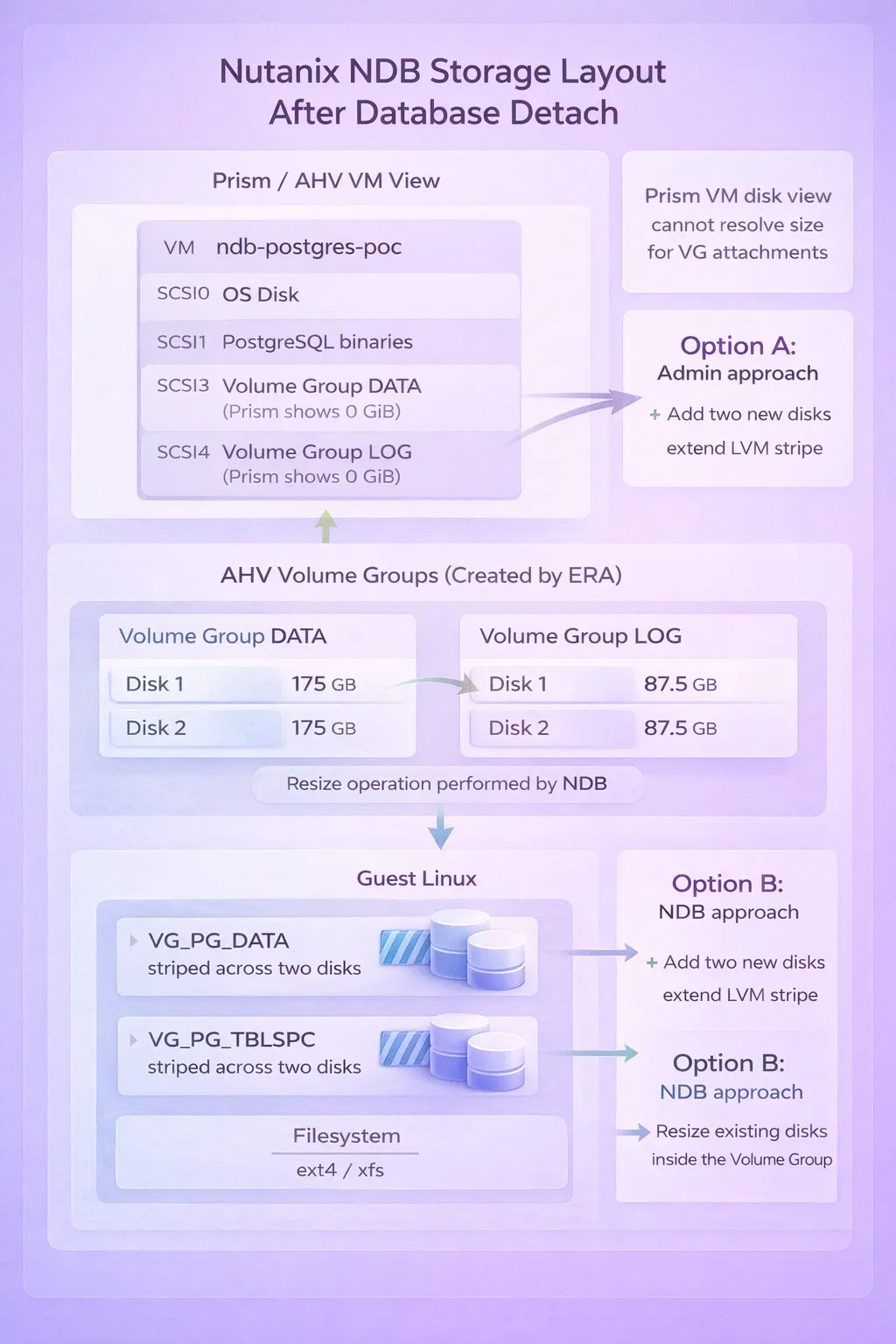
The result in Prism looks strange: the VM shows disk attachments at scsi.3 and scsi.4 with a reported size of 0 bytes. This is not corruption. Prism simply cannot determine the size of Volume Group attachments the way it can for regular vDisks.
Inside the guest OS, everything looks normal. You see two LVM Volume Groups (VG_PG_DATA for the data directory, VG_PG_TBLSPC for tablespaces), each striped across two physical volumes, with ext4 or xfs filesystems on top.
The key insight: NDB manages storage at the Nutanix layer, but the guest OS owns standard LVM and filesystems. Nothing proprietary at the data level.
The Software Layer
NDB also controls how PostgreSQL binaries get deployed. Rather than installing from OS repositories, NDB mounts a dedicated vDisk containing its own PostgreSQL build at /usr/pgsql-15. The service unit (era_postgres.service) points to these binaries.
This means PostgreSQL updates happen through NDB workflows, not through standard package management. For environments actively using NDB capabilities, this centralized approach provides consistency across database fleets.
For standalone databases where NDB features are not required, the binaries can be replaced with OS-managed packages while keeping the data in place.
Restoring OS Repositories
This step is easy to miss if you start from a clean PostgreSQL VM, because the NDB-provisioned image handles repositories differently.
On the custom Nutanix image, the standard Rocky Linux repository files are blanked. The file carries a clear marker:
# Blanked default repos for custom Nutanix image. Do not remove this filePackage resolution is instead routed through a Nutanix repository (nutanix_rocky8.repo) that points to an internal artifactory:
baseurl=https://artifactory.dyn.ntnxdpro.com/artifactory/ntnx-rocky-8-live/...This works inside the Nutanix build environment, but the host is not resolvable from a standard network. Any dnf operation fails on metadata download.
To run PostgreSQL from standard OS packages, restore the default Rocky repositories first.
Remove the Nutanix repository file:
rm -f /etc/yum.repos.d/nutanix_rocky8.repoRecreate the base repositories:
cat <<'EOF' > /etc/yum.repos.d/Rocky-BaseOS.repo
[baseos]
name=Rocky Linux $releasever - BaseOS
baseurl=https://dl.rockylinux.org/pub/rocky/$releasever/BaseOS/$arch/os/
gpgcheck=1
enabled=1
gpgkey=file:///etc/pki/rpm-gpg/RPM-GPG-KEY-rockyofficial
EOF

cat <<'EOF' > /etc/yum.repos.d/Rocky-AppStream.repo
[appstream]
name=Rocky Linux $releasever - AppStream
baseurl=https://dl.rockylinux.org/pub/rocky/$releasever/AppStream/$arch/os/
gpgcheck=1
enabled=1
gpgkey=file:///etc/pki/rpm-gpg/RPM-GPG-KEY-rockyofficial
EOF

cat <<'EOF' > /etc/yum.repos.d/Rocky-PowerTools.repo
[powertools]
name=Rocky Linux $releasever - PowerTools
baseurl=https://dl.rockylinux.org/pub/rocky/$releasever/PowerTools/$arch/os/
gpgcheck=1
enabled=1
gpgkey=file:///etc/pki/rpm-gpg/RPM-GPG-KEY-rockyofficial
EOF
Refresh the cache and confirm the repositories resolve:
dnf clean all
dnf repolist
With the standard repositories in place, the PostgreSQL installation in the next step proceeds normally.
Note The PowerTools repository is disabled by default on stock Rocky. Enable it if any dependency requires it during installation.
Removing the NDB Layer
The removal process targets the software layer only. Data stays exactly where it is.
Step 1: Stop the NDB-managed service
systemctl stop era_postgresStep 2: Unmount the NDB binary disk
umount /usr/pgsql-15Step 3: Install PostgreSQL from OS repositories
On Rocky Linux 8.10:
dnf module enable postgresql:15 -y
dnf install postgresql-server postgresql -y
The binaries now live at /usr/bin/postmaster instead of /usr/pgsql-15/bin/postmaster.
Step 4: Create a systemd override to point at the existing data directory
mkdir -p /etc/systemd/system/postgresql.service.d
cat <<'EOF' > /etc/systemd/system/postgresql.service.d/override.conf
[Service]
Environment=PGDATA=/pgsql/ndb-postgres-poc/data
EOF
systemctl daemon-reload
Step 5: Disable the old service, enable the new one
systemctl disable era_postgres
systemctl enable postgresql
systemctl start postgresql
Step 6: Verify
systemctl status postgresql
psql -c "SELECT version();"
PostgreSQL starts, reads the existing data directory, and runs normally. No data migration. No export/import. The same files, the same tablespaces, the same databases.
Cleaning Up the Agent
NDB installs an agent on each managed VM for communication with the NDB server. Once you have removed the database from NDB management, the agent serves no purpose.
Check if it is running:
ps aux | grep ndbIf you see ndb_agent or ndb_controller processes, stop and remove them:
systemctl stop ndb_agent ndb_controller
dnf remove era-agent
rm -rf /opt/era_base
One more cosmetic detail: the custom Nutanix kernel leaves a configuration file that triggers a harmless warning during package operations.
/sbin/ldconfig: /etc/ld.so.conf.d/kernel-5.10.x.el8.nutanix.x86_64.conf:6: hwcap directive ignoredIt does not affect functionality. If you prefer a clean output, remove the file:
rm -f /etc/ld.so.conf.d/kernel-*.nutanix.*.conf
ldconfig
Expanding Storage After NDB Removal
The storage still works after removing NDB, but expansion requires understanding the original design.
NDB provisions storage with LVM striping across two physical volumes. The mount options confirm this:
/dev/mapper/VG_PG_DATA-LV_PG_DATA on /pgsql/ndb-postgres-poc/data type ext4 (rw,relatime,seclabel,stripe=512)This improves throughput but has implications when you need more space.
Option A: Resize the existing Volume Group disks (preferred)
Expanding the disks inside the existing Volume Group maintains the stripe configuration. Both disks grow proportionally, and the LV extends cleanly.
From the CVM:
acli vg.disk_update <volume-group-uuid> 0 new_size=300G
acli vg.disk_update <volume-group-uuid> 1 new_size=300G
Inside the VM:
echo 1 > /sys/class/block/sde/device/rescan
echo 1 > /sys/class/block/sdf/device/rescan
pvresize /dev/sde
pvresize /dev/sdf
lvextend -l +100%FREE /dev/mapper/VG_PG_DATA-LV_PG_DATA
resize2fs /dev/mapper/VG_PG_DATA-LV_PG_DATA
Option B: Add new disks (requires attention)
Adding a third disk to a striped LV creates a geometry mismatch. The lvextend command cannot maintain the original stripe configuration and silently does nothing.
The workaround is forcing linear allocation:
pvcreate /dev/sdX
vgextend VG_PG_DATA /dev/sdX
lvextend -l +100%FREE -i 1 /dev/mapper/VG_PG_DATA-LV_PG_DATA
resize2fs /dev/mapper/VG_PG_DATA-LV_PG_DATA
The -i 1 flag tells LVM to extend without striping. The LV becomes a mix of striped and linear segments. It works, but the original performance characteristics are partially lost.
When possible, resize existing disks rather than adding new ones.
Backup Without NDB
With NDB removed, Time Machine is no longer available. For backup, HYCU provides application-aware protection for PostgreSQL. It understands Postgres consistency requirements and can perform proper backups without the NDB layer.
Alternatively, standard VM-level snapshots plus pg_dump for logical backups cover most use cases. The point is: you have options. Nothing about the post-NDB state limits your backup strategy.
What NDB Actually Leaves Behind
After removing NDB, here is what remains on the VM:
- A standard Linux filesystem layout with LVM logical volumes
- The PostgreSQL data directory at
/pgsql/<instance>/data - Tablespaces at
/pgsql/<instance>/tsdata - Standard ext4 filesystems with striping enabled
- The
eraandpostgresusers
What does not remain:
- The mounted binary disk at
/usr/pgsql-15 - The
era_postgres.serviceunit - The NDB agent and controller processes
- Any dependency on the NDB server
The mount output tells the whole story:
mount | grep pgsql/dev/sdb on /usr/pgsql-15 type ext4 (rw,relatime,seclabel,stripe=256)
/dev/mapper/VG_PG_DATA-LV_PG_DATA on /pgsql/ndb-postgres-poc/data type ext4 (rw,relatime,seclabel,stripe=512)
/dev/mapper/VG_PG_TBLSPC-LV_PG_TBLSPC on /pgsql/ndb-postgres-poc/tsdata type ext4 (rw,relatime,seclabel,stripe=512)The binary disk (/dev/sdb) is a mount, not an installation. The data and tablespace volumes are standard LVM. Nothing proprietary.
Why This Approach Works
Before converting, you can validate that the database runs independently of NDB:
su - postgres
/usr/pgsql-15/bin/pg_ctl -D /pgsql/ndb-postgres-poc/data start
If PostgreSQL starts and accepts connections, the data directory is healthy and self-contained. NDB was orchestrating the service, not owning the data.
The conversion works because PostgreSQL data directories are portable across installations of the same major version. The OS-packaged PostgreSQL 15 reads the same data format as the NDB-deployed PostgreSQL 15. No conversion, no dump/restore, no compatibility layer.
The only change is where the binaries come from. The data stays exactly where it is.
When This Makes Sense
This approach fits when:
- NDB lifecycle features (Time Machine, cloning, automated patching) are not required
- You prefer PostgreSQL updates through standard OS package management
- The database runs standalone and does not depend on NDB provisioning workflows
Keep NDB when:
- Time Machine is actively used for point-in-time recovery
- Cloning supports dev/test refresh cycles
- Centralized patching across multiple databases adds operational value
- The database is part of a provisioning workflow that depends on NDB profiles
The conversion is one-way. Re-enrolling a database into NDB after removal requires a fresh deployment or manual re-registration.
The Actual Point
NDB is a layer. It provides real value when you use its capabilities: Time Machine for point-in-time recovery, cloning for dev/test refresh, automated patching across database fleets, provisioning profiles for standardization.
But the data layer underneath remains standard. Removing NDB does not require migrating data, exporting databases, or rebuilding anything. The data directory is just a data directory. The filesystems are just filesystems. PostgreSQL is just PostgreSQL.
That is what portability looks like in practice.